AI Overview:
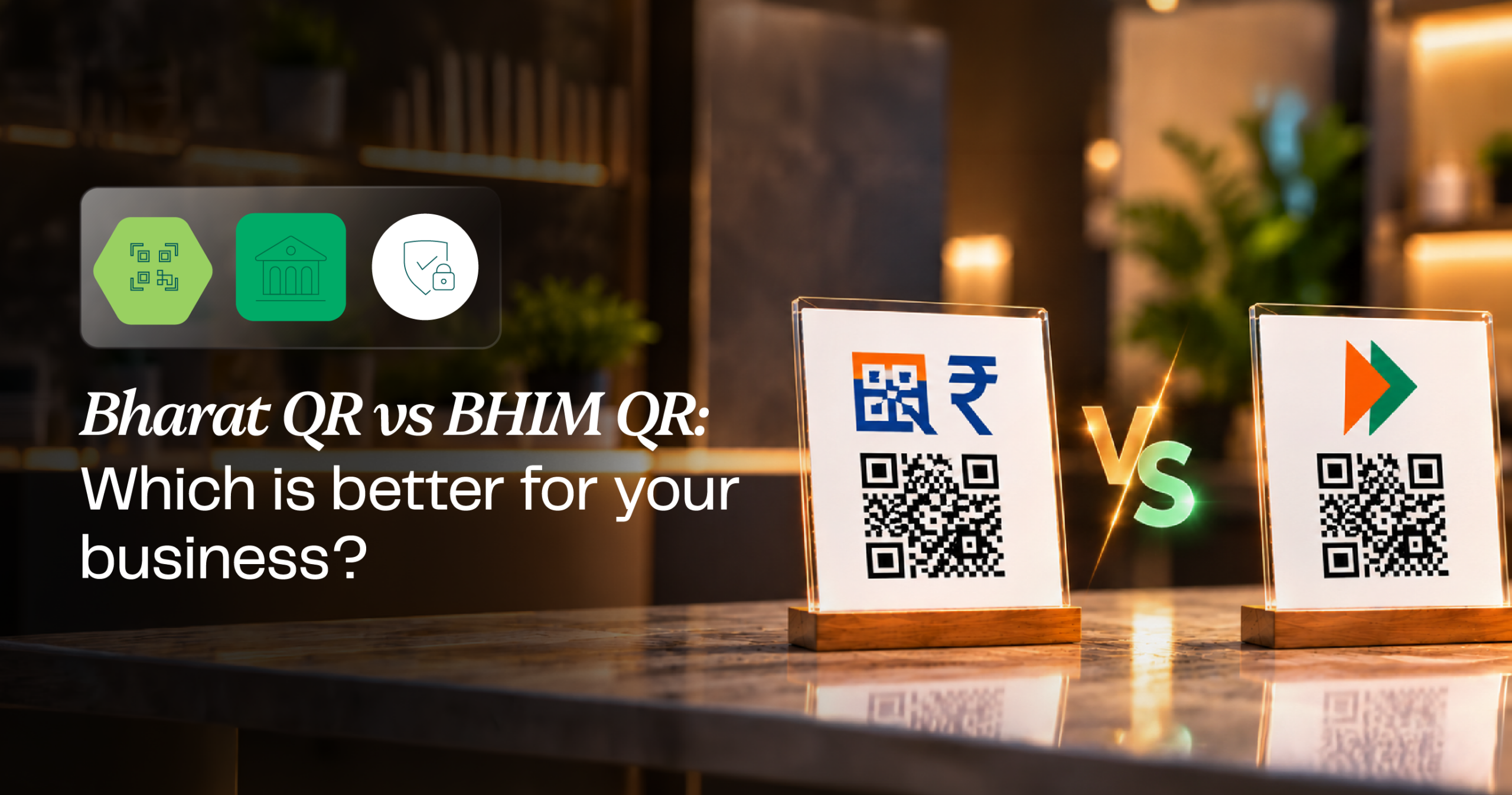
Bharat QR and BHIM QR are both RBI-approved, interoperable QR codes used across India, but they run on different payment rails and suit different transaction types. Bharat QR is a card-based code built jointly by NPCI, Visa, Mastercard, RuPay, and American Express, so it debits a linked debit, credit, or prepaid card and works only for person-to-merchant payments.
BHIM QR runs on UPI and uses a virtual payment address instead of card details, so it supports person-to-person and person-to-merchant transfers straight from a bank account, and is generally the faster, lower-friction option for everyday retail. Both codes carry similar RBI-backed security standards, though authentication differs: card PIN or OTP for Bharat QR, and UPI PIN for BHIM QR.
In the Bharat QR vs BHIM QR comparison, most Indian merchants gain more by accepting both rather than picking one, since UPI covers the bulk of daily transaction volume while card-linked payments still matter for higher-value purchases. This guide breaks down the differences in security and speed and shows how a single UPI payment gateway such as Pine Labs Online Payments lets a business accept Bharat QR, BHIM QR, and every UPI app through one connection.If you have wondered why some QR scanners and online checkout portals say “Bharat QR” while others carry the UPI logo, you are not alone. In the Bharat QR vs BHIM QR debate, both are RBI-approved and interoperable, but they move money on different rails, and picking the wrong one, or offering both without a proper setup, can quietly cost you sales.
This guide compares Bharat QR and BHIM QR on their differences, security, and transaction speed, explains where a UPI payment gateway fits in, and helps you decide which one, or which combination, actually works for your business.
What Is Bharat QR?
Bharat QR is India’s first interoperable, card-based QR code, built jointly by NPCI, Visa, Mastercard, RuPay and American Express, so a single code accepts payments across all four card networks.
It runs purely on card rails. A customer scans the code through a Bharat QR-enabled banking app, enters the amount, and authorises the payment using a card already linked to their bank. No cash changes hands, and the merchant does not need a separate card machine for each network.
- Works only for merchant payments (P2M), not person-to-person transfers
- Draws funds from a linked debit, credit, or prepaid card, not a bank balance directly
- Backed by RuPay, Visa, Mastercard, and American Express, so almost any card works at the same counter
- Needs a Bharat QR-enabled banking app on the customer’s side and a bank-linked merchant account on the business’s side
What Is a BHIM QR Code?
A BHIM QR code is a UPI-based QR code generated through the BHIM app, or any UPI app, and encoded with the merchant’s or individual’s Virtual Payment Address (VPA) instead of card or account numbers.
Because it runs on UPI rather than card networks, BHIM QR supports both person-to-person and person-to-merchant transfers, moving funds directly from the payer’s bank account within seconds. It works with any UPI-enabled app, not only BHIM, and comes in static form, where the customer types the amount, and dynamic form, where the amount is preset. No card or card registration is needed at any stage.
Bharat QR vs BHIM QR: Key Differences
Once you see how each code moves money, the Bharat QR vs BHIM QR decision comes down to a handful of practical differences, including how each is secured and how fast each settles.
| Basis | Bharat QR | BHIM QR (UPI) |
|---|---|---|
| Payment source | Debit, credit, or prepaid card | Bank account via Virtual Payment Address |
| Transaction type | Person-to-merchant (P2M) only | Person-to-person and person-to-merchant |
| Settlement rails | Visa, Mastercard, RuPay, American Express | UPI, via NPCI |
| Authentication | Card PIN or OTP through the card network | UPI PIN through the customer’s bank |
| Typical settlement speed | Instant customer confirmation; merchant-side settlement can follow standard card network cycles | Near-instant confirmation and credit to the merchant’s linked bank account |
| App needed | Bank’s mobile banking app, enabled for Bharat QR | Any UPI app: BHIM, GPay, PhonePe, Paytm and more |
| Best suited for | Customers who default to card payments, often on higher-value purchases | Customers who prefer paying straight from a bank account |
In practice, UPI-linked codes cover a far larger share of daily digital transactions in India, and most merchants find BHIM QR the quicker, lower-friction option at checkout. Bharat QR still matters for customers who default to card payments, particularly on bigger-ticket purchases where a linked card is the natural choice.
CTA: Check out Pine Labs In-store Point of Sale Machines
Button: Visit Now
What Is a UPI Payment Gateway, and Where Does It Fit In?
A UPI payment gateway is the software layer that lets a business accept UPI payments, whether through a QR code, a payment link or a checkout page, and settles funds into its account without a direct connection to NPCI.
Neither Bharat QR nor BHIM QR is something a business switches on by itself. A bank, PSP or payment aggregator issues the code, handles certification and security checks, and manages settlement and reconciliation behind the scenes. Every QR code payment your business accepts, whether through Bharat QR or BHIM QR, ultimately routes through this gateway layer, which is why the provider you choose matters as much as the QR code itself.
How to Choose the Right QR Code for Your Business
Picking the right QR code for business use is not about choosing a side. It is about matching the code to how your customers actually pay and how fast you need funds to settle:
- If most customers already carry a UPI-enabled QR code app on their phone, make BHIM or UPI QR your primary code at the counter
- If you serve a higher-value or card-first customer base, such as jewellery, electronics or travel, keep Bharat QR active alongside UPI
- If you sell online as well as in-store, make sure customers can scan the QR code online during checkout, not only at a physical counter
- If you run multiple outlets, use a gateway that can generate and track a unique code for each one
- If reconciliation across providers is a headache, choose a single QR that reads both card and UPI networks instead of running two separate stickers
CTA: Not sure which QR code fits your online business? Pine Labs can help you choose and set up the right combination.
Button: Get Started Today
How Pine Labs Online Payments Helps You Accept Every QR Code
Every time a customer scans the wrong QR code or finds none at all, a sale is at risk, and two separate stickers also mean two settlement files and two places for a payment to fail quietly.
At Pine Labs, we built online payments infrastructure so merchants never have to make that trade-off. Our platform generates a single digital QR code that accepts Bharat QR, BHIM QR, and every other major UPI app at a physical counter or during online checkout.
- One QR code instead of two stickers, so customers never have to hunt for the right one
- One settlement dashboard across online and in-store channels, so reconciliation is never split across providers
- One connection to manage certification and security checks as card and UPI rules evolve
This is the commercial case for consolidating QR acceptance under one gateway: it protects revenue that would otherwise be lost to a missing or mismatched code at the counter. Our guides on UPI merchant QR codes and how PSPs power UPI cover the plumbing behind each scan in more detail.
Conclusion
Bharat QR and BHIM QR solve the same problem of letting customers pay without cash, but they move money on different rails. Bharat QR draws on card networks for merchant-only payments, while BHIM QR runs on UPI and covers both person-to-person and merchant transfers, usually settling faster and with fewer steps for everyday transactions.
Rather than picking a side, most businesses are better served accepting both through a single UPI payment gateway. Pine Labs Online Payments brings Bharat QR, BHIM QR, and every UPI app together under one connection and one dashboard, so your business never turns away a sale over the wrong QR code at the counter.
FAQs
What is the main difference between Bharat QR and BHIM QR?
Bharat QR debits a linked card, while a BHIM QR code pulls funds straight from a bank account through UPI, and only BHIM QR supports person-to-person transfers.
Which is better for a small business, Bharat QR or BHIM QR?
Most small merchants find UPI easier to run day-to-day, since customers can scan a QR code online or in-store without a linked card, though accepting both avoids losing card-first shoppers.
Is BHIM QR more secure than Bharat QR?
Neither is less secure. Both sit on RBI-approved rails, and every QR code payment is authenticated separately, by card PIN or OTP for Bharat QR and UPI PIN for BHIM QR.
Which QR code settles faster, Bharat QR or BHIM QR?
Both confirm to the customer within seconds, but BHIM QR typically credits a merchant’s account sooner, since Bharat QR can follow standard card network settlement cycles.
Which QR code should I display at my counter?
Most businesses do better displaying one digital QR code that reads both Bharat QR and BHIM QR, rather than choosing a single standard.
Do Bharat QR and BHIM QR work with the same apps?
No. Bharat QR needs a Bharat QR-enabled banking app linked to a card, while BHIM QR works with any UPI QR code app, including BHIM, GPay and PhonePe.
Can one gateway accept both Bharat QR and BHIM QR?
Yes, a combined QR code for business setup through a single payment gateway can generate one code that reads both card-based and UPI payments.