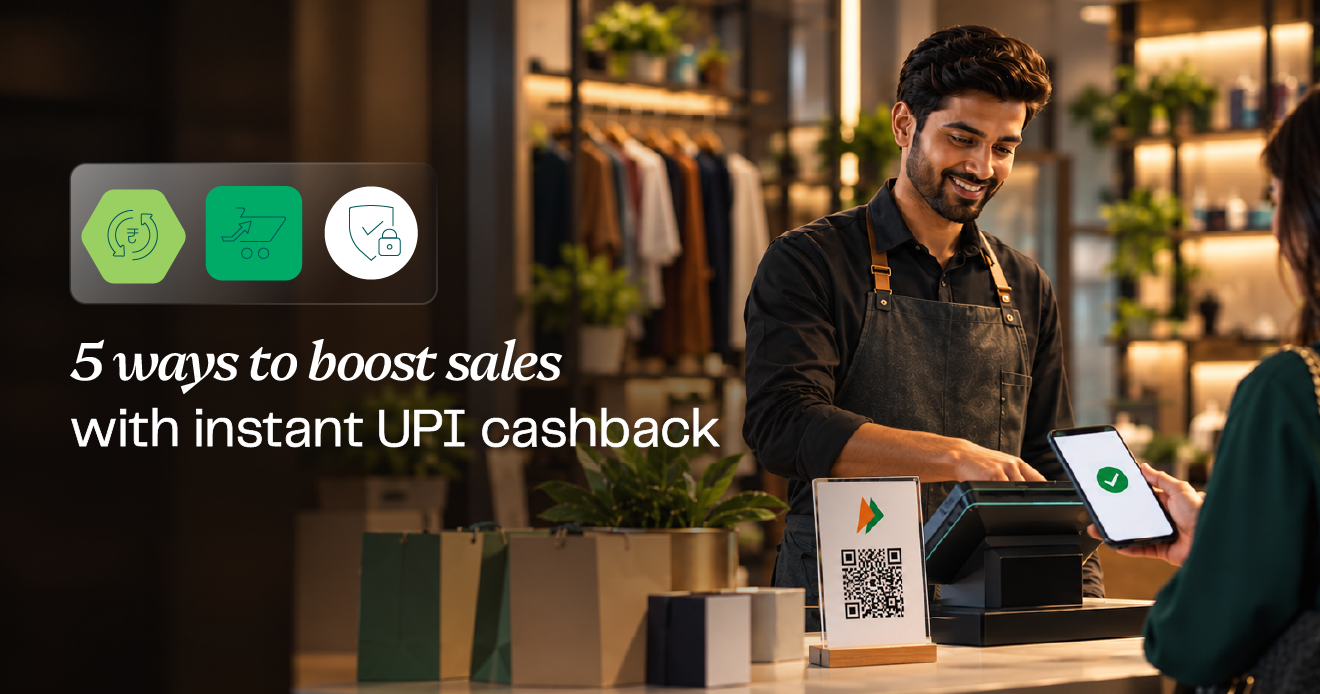
At checkout, a small cashback offer can be the nudge that turns consideration into a purchase. With Instant Cashback (ICB) on UPI, Pine Labs helps merchants offer instant discounts at the point of payment, making cashback a simple tool to drive in-store sales.
At Pine Labs, we see this at checkout every day through Instant Cashback (ICB) on UPI, a native capability that applies a discount the moment a customer pays. Here are five ways cashback on UPI payments can lift in-store sales
What Is Instant Cashback on UPI?
Instant Cashback on UPI is an immediate discount applied directly at checkout when a customer pays via UPI, rather than a reward credited after the purchase.
- The customer pays the discounted amount upfront; there is no waiting for cashback to arrive later.
- It works across both EMI and non-EMI UPI transactions.
- The brand funds the cashback, so the merchant does not have to absorb the discount.
- It sits at the payment step itself, not on the product price shown earlier in the journey.
– It is important to understand the distinction here. Most people ask what is cashback picture money credited to their account a few days after a purchase. Instant Cashback on UPI removes that gap entirely, which changes how it behaves as a sales tool.
5 Ways Cashback on UPI Payments Can Boost In-Store Sales
Positioned correctly, cashback on UPI payments does more than shave a few rupees off the bill. Here is how it moves the needle.
1. Increase Conversion at Checkout
For a shopper who is already leaning toward buying, an immediate saving can be the final nudge. As the discount is deducted at the point of payment rather than earlier in the browsing journey, it lands at the exact moment hesitation is highest, right before the customer commits. This makes cashback on UPI payments a checkout-stage lever rather than a top-of-funnel promotion, which is why brands increasingly treat it as part of the payment experience itself, not just the marketing campaign built around a sale.
2. Encourage Customers to Choose UPI
Cashback on UPI payments can steer transaction volume towards UPI without asking the merchant to fund the discount. As it is the brand that carries the cost, merchants get a lever to promote a fast, low-friction payment rail, while customers get a concrete reason to pick it over cards or net banking. Over time, this can shift a meaningful share of checkout volume towards UPI at no extra cost to the retailer, while customers get an instant discount simply for choosing it.
3. Drive Higher-Value Purchases
Cashback on UPI payments makes upgrading to a pricier product feel more justified. A shopper deciding between a mid-range and a flagship smartphone, or a standard and a premium laptop is more likely to trade up when an instant discount narrows the price gap at the exact moment they are comparing options. Electronic products see this type of behaviour the most since ticket sizes are so large that even a modest cashback changes the math for the customer.
4. Create More Compelling Product Offers
Instead of cutting the headline price of a product, brands can use cashback on UPI payments to build an additional incentive around specific categories or SKUs. This keeps the sticker price intact for brand positioning while giving the customer a reason to act immediately. Moreover, this also lets the brand run offers on selected products without discounting its entire catalogue.
5. Drive More Value Without Increasing Merchant Discounting
This is the commercial case in one line: the brand funds the cashback, the customer gets an instant saving, and the merchant gets a stronger offer at checkout without absorbing the discount. For a merchant weighing up how much margin to give away on a promotion, cashback on UPI payments offers a way to run a compelling offer while keeping their own discounting exposure unchanged.
Brand-Funded Cashback: How Does It Work?
The mechanism behind cashback on UPI payments is a three-way value exchange, and understanding it explains why it differs from a standard merchant-funded sale.
- Brand: funds the cashback to promote its own products, treating it as a marketing or acquisition cost rather than a margin cut.
- Merchant: enables the offer at checkout and gets a stronger proposition to show customers, without discounting from its own margin.
- Customer: gets an instant saving at the point of payment, with no separate claim or redemption step.
This is the piece that differentiates instant cashback on UPI from conventional merchant-funded discounts where the retailer absorbs the entire cost of the offer.
Instant Cashback on UPI vs Traditional Cashback
| Traditional Cashback | Instant Cashback on UPI |
| Customer pays the full amount at checkout | Discount is applied at the point of payment |
| Cashback is credited later, often days after the purchase | Customer pays the reduced amount immediately |
| Usually needs a separate claim or redemption step | No waiting and no separate redemption journey |
People searching how does cashback work are often picturing the traditional model on the left. Instant Cashback on UPI collapses the gap between purchase and reward into a single step at checkout.
Instant Cashback on UPI vs EMI on UPI
Both sit at the UPI payment step, but solve different problems.
- EMI on UPI: helps customers split a payment into instalments using an eligible or pre-approved UPI credit line, so the total amount owed stays the same but is spread over months.
- Instant cashback on UPI: reduces the amount payable at checkout itself, so the customer pays less in total, not the same amount over a longer period.
Depending on the offer running at checkout, customers may see one option or both together on a single purchase.
How Pine Labs Enables Instant Cashback on UPI
At Pine Labs, we build cashback on UPI payments directly into the UPI checkout experience, both online and in store.
- An instant discount is applied at checkout the moment a customer selects UPI as their payment method.
- Offer discovery and eligibility checks happen in real time, so customers see exactly what applies to their purchase.
- Coverage is for both EMI and Non-EMI UPI transactions.
- Offers can be funded by the brand, the merchant, or split between both, depending on the campaign.
- Merchant checkout integration means the offer surfaces natively at the point of sale, with no separate app or redemption flow required
For merchants, this turns a routine UPI payment into a growth lever rather than a plain transaction. To see how it fits into your checkout, explore our UPI payment solutions.
Conclusion
Cashback on UPI payments works best when it is treated as a checkout-stage sales lever, not an afterthought bolted onto a loyalty scheme. As the brand funds it rather than the merchant, retailers get a stronger offer at the point of payment without giving up their own margin, which is the core commercial case behind instant cashback on UPI.
If you are looking to put instant discounts in front of customers at the exact moment they decide to buy across in-store and online checkout, get in touch with our team and we will map out the right setup for your business.
FAQs
What is cashback on UPI payments?
It is a discount applied at the point of payment when a customer pays a merchant via UPI, rather than a reward credited to their account after the purchase. How does cashback work, and is it different on UPI?
In the traditional model, a customer pays the full amount and receives cashback later, often after a claim step. On UPI, instant cashback applies the discount at checkout itself, so the customer pays less upfront with nothing to redeem afterwards.
What is cashback on UPI payments, and does it work with every UPI app?
Cashback on UPI payments is an instant discount applied when checkout is completed via UPI. Availability depends on the specific offer running at that merchant, funded by the brand or merchant, rather than being tied to one particular UPI app.
Is instant cashback the same as an instant discount?
They describe the same effect from slightly different angles: both reduce the amount a customer pays at checkout, applied immediately rather than credited later. The difference is mostly in who is funding it and how the offer is being marketed.
How is cashback different from a loyalty program in retail?
A loyalty program in retail rewards repeat customers over time, typically through points collected across multiple visits. Cashback on UPI payments applies to a single transaction immediately, which makes it a conversion tool for that purchase rather than a long-term retention mechanic.
Can instant discounts improve customer retention and turn shoppers into repeat customers?
An instant discount mainly influences the purchase decision in front of the customer, but a positive checkout experience, including a visible saving, can encourage repeat customers to return. For customer retention strategies built around ongoing engagement, brands typically pair instant cashback with a separate loyalty mechanic rather than relying on cashback alone.
CTA: Want to put instant cashback on UPI in front of every customer at checkout?