Digital payments have become central to how retail transactions take place across India. Card usage, UPI adoption and contactless payments continue to grow as customers increasingly expect fast and seamless checkout experiences. Industry estimates suggest India’s digital payments market could exceed $10 trillion in annual transaction value in 2026, reflecting the rapid shift toward cashless commerce.
As this growth accelerates, merchants are processing a larger share of their revenue through PoS terminals. Yet payment acceptance is only one part of the equation. The costs behind every transaction often receive far less attention, even though they directly influence profitability.
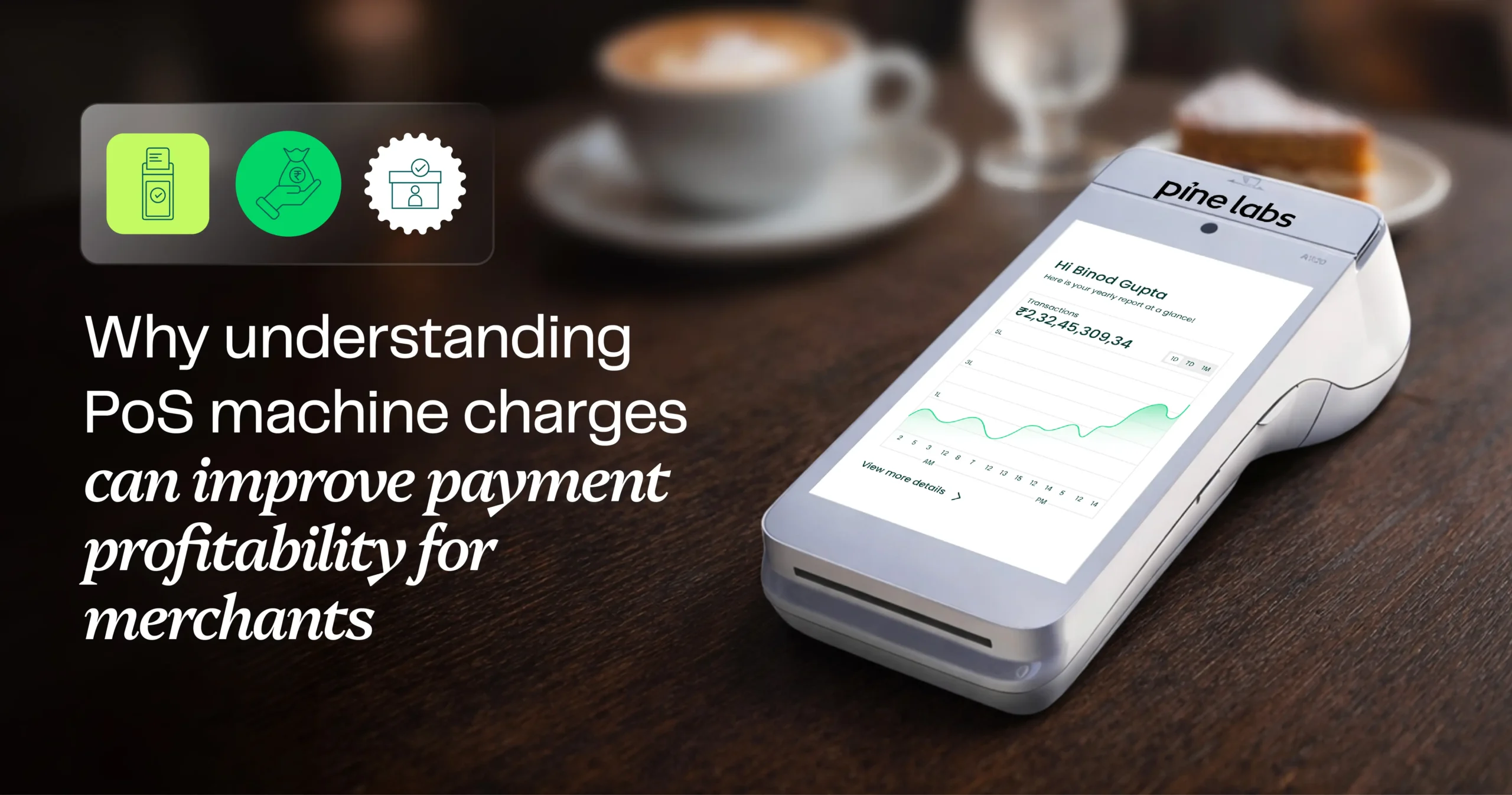
At Pine Labs, we work closely with merchants scaling across multiple locations and sales channels. Understanding how PoS machine charges work is, therefore, an important step toward improving payment profitability and operational efficiency. Let’s explore why this matters for modern merchants.
Payment costs that quietly influence merchant margins
For many businesses, PoS terminals are treated as a basic operational requirement rather than a financial lever. As a result, payment-related costs often receive limited scrutiny.
In practice, PoS machine charges can include several cost components that influence transaction profitability:
- Merchant Discount Rate (MDR) applied on card payments
- Monthly PoS terminal rental or subscription fees
- Transaction processing charges across networks
- Settlement or service fees depending on providers
In some cases, merchants may also encounter fees such as a PoS decline charge, which can occur when certain card transactions fail during processing.
When these costs are not monitored carefully, merchants may experience:
- Reduced margins on high-ticket transactions
- Billing inefficiencies during peak store hours
- Limited visibility into transaction-level costs
- Reconciliation challenges across multiple stores or payment channels
For retailers operating across multiple outlets and payment methods, these small cost layers can accumulate quickly.
Merchants who actively analyse their payment infrastructure often discover opportunities to improve both operational efficiency and payment profitability.
The evolution of PoS infrastructure in modern retail
Payment systems are rapidly evolving beyond traditional card-swiping terminals. Today’s commerce environment demands infrastructure that connects payments with billing, reporting and operational intelligence.
Several developments are shaping this evolution:
- Integrated billing and payment systems that minimise manual reconciliation
- Automated transaction reporting that improves cost visibility
- Intelligent payment routing that supports smoother transaction processing
- Unified dashboards that track payment performance across channels
When merchants gain visibility into payment flows and transaction data, they are better equipped to optimise checkout experiences and manage operational costs.
Pine Labs PoS systems support this transition toward smarter checkout environments. We bring together billing, payment acceptance and analytics so merchants can manage payment operations more effectively as they scale.
How payment visibility improves everyday merchant operations
Merchants who actively evaluate PoS machine charges often uncover opportunities to streamline operations and strengthen profitability.
Several practical benefits emerge when payment infrastructure is managed strategically.
- Improved checkout efficiency
Modern PoS systems combine billing and payment processing into a single workflow, helping retailers reduce checkout friction during busy store hours.
Merchants benefit from:
- Faster transaction processing
- Reduced manual verification errors
- Smoother payment experiences for customers
- Greater control over transaction costs
Clear visibility into payment costs allows merchants to better understand transaction-level profitability.
This helps businesses:
- Evaluate payment method usage across stores
- Monitor payment-related expenses more effectively
- Align payment infrastructure with operational needs
- Simpler reconciliation across stores
Retail operations frequently involve multiple stores, payment methods and daily transaction volumes.
Integrated PoS platforms simplify reconciliation through:
- Automated settlement tracking
- Unified payment reporting
- Accurate transaction records
Industry insights suggest that integrated payment systems can reduce reconciliation effort by up to 40 percent, helping merchants save operational time.
At Pine Labs, we see this transformation first-hand. By combining faster checkout capabilities with automation and reporting tools, payment systems can move beyond basic acceptance and become a strategic advantage for merchants.
Improve payment efficiency with smarter PoS infrastructure
For modern retailers, payment infrastructure plays a much larger role than simply accepting transactions. It directly influences checkout speed, operational efficiency and revenue realisation. Understanding PoS machine charges gives merchants better visibility into payment economics and helps identify opportunities to optimise payment operations across stores.
As digital payments continue to expand, businesses that actively manage payment infrastructure will be better positioned to improve margins and scale efficiently. Explore how integrated PoS systems and dynamic payment infrastructure can help merchants reduce complexity, improve transaction accuracy and support long-term business growth.