

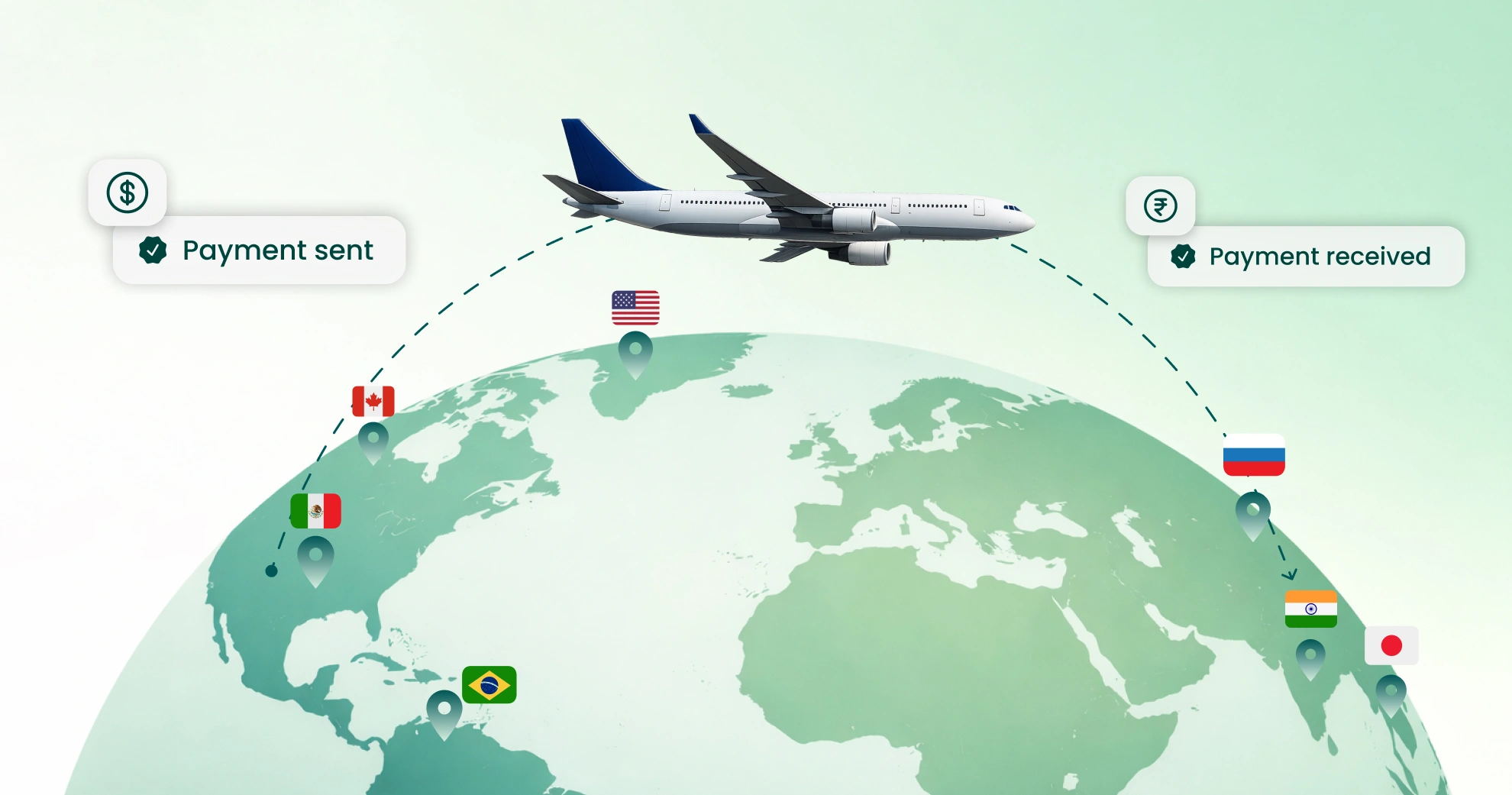
The real competition for international routes isn’t another airline.
It’s FX leakage hidden inside your payment gateway.
International routes are meant to be high-margin profit engines for airlines. Yet for many Indian carriers, these routes are quietly turning into margin traps – not because demand is weak, but because the payment gateway for airlines is not built for cross-border scale.
With strong Indian diaspora traffic across the Middle East and Southeast Asia, and rising outbound travel from Tier-2 cities, demand for international routes is at an all-time high.
What’s holding profitability back is invisible friction at checkout: high cross-border fees, poor FX transparency, fragmented settlements, and limited payment flexibility.
For modern airlines, international growth is no longer about adding routes alone. It’s about ensuring that every international booking converts into maximum net revenue without payment leakage.
The great balancing act for airline revenue teams
As airlines push for international market share, payment complexity compounds. Revenue owners are forced to trade off growth against operational stability—often without real-time visibility.
1. Too many PSPs, no unified payment gateway
To localise payments in the Gulf or Southeast Asia, airlines typically integrate multiple local PSPs.
But multiple PSPs create a fragmented payment gateway stack:
- Different settlement cycles
- Inconsistent fee structures
- Disjointed reconciliation
- Poor real-time cash visibility
Instead of enabling growth, the payment gateway becomes operational drag.
2. Disruption seasons expose payment infrastructure fragility
Monsoons, fog, ATC restrictions, or regional shutdowns trigger mass cancellations. Refund volumes spike overnight.
When your payment gateway for airlines isn’t built for elasticity:
- Refund queues pile up
- Reconciliation cycles stretch
- Liquidity tightens
- Route-level profitability is compromised
A route that is profitable on paper can turn negative simply because refund velocity cannot keep up with refund volume.
3. No real-time FX lock = trust loss + chargebacks
Without controlled FX conversion at checkout:
- Customers see different amounts on their statements
- Trust erodes
- Chargebacks rise
Each inefficient FX conversion rail thins net margin per seat. Across high-volume international routes, even small FX leakage compounds into significant monthly revenue loss.
4. High intent doesn’t guarantee booking completion
International travellers show high intent, but affordability gaps kill conversions.
Without EMI or BNPL embedded directly into the airline payment gateway:
- Customers abandon high-value bookings
- AOVs stagnate
- Load factors suffer
Payment flexibility is no longer optional – it’s a route-level growth lever.
5. Generic risk engines reject real revenue
Airlines must manage fraud risk, but generic risk engines often flag legitimate international travellers as high-risk.
The result:
- False declines
- Lost revenue
- Poor customer experience
Revenue teams are forced to choose between fraud exposure and rejecting valid bookings—an avoidable trade-off with airline-specific risk logic.
The zero-compromise flight plan: What modern airline payment gateways do differently
Leading global carriers have solved these challenges by rethinking payments as infrastructure, not utilities.
1. A centralised financial command centre
A modern payment gateway for airlines must act as a single command centre:
- One API
- One ledger
- One reconciliation surface
- Live, route-level visibility
Why this matters
- Settlement speed should not dictate liquidity
- Reconciliation should not require spreadsheets across time zones
- Cash visibility must shift from weekly to real-time
A 1% drop in payment success on a high-demand DEL–DXB route can erase revenue equivalent to three fully booked flights per month. Centralisation prevents these silent leaks.
2. Transparent FX conversion with revenue participation
Travellers don’t just buy seats – they buy confidence in the final amount.
A modern airline payment gateway must enable:
- Transparent FX conversion at checkout
- Controlled pricing logic
- Revenue share on FX instead of leakage
Even minor FX mispricing across trunk routes can compound into lakhs of rupees in lost margin every month.
3. Instant refund velocity as a revenue safeguard
Refunds are now a real-time expectation.
Delayed refunds:
- Spike dispute ratios by 0.5–0.7%
- Increase chargeback costs
- Turn profitable months negative during disruption seasons
High-velocity refunds are no longer a CX feature – they are a financial risk control mechanism.
4. The affordability bridge: EMI and BNPL at checkout
Leading airlines treat affordability as a growth lever.
Low-cost carriers like AirAsia and Scoot embed local EMI and BNPL options directly into checkout, especially on competitive international routes.
Results:
- 8–12% lift in conversions
- Higher AOVs
- Improved load factors on new routes
A payment gateway for airlines must close the High-Intent vs Completed-Booking gap.
Is your payment gateway accelerating international growth – or anchoring it?
For Indian aviation leaders, this is no longer a vendor decision.
It’s an operating philosophy shift.
Every operational drag -FX leakage, fragmented reconciliation, refund delays – is the result of treating payments as a commodity instead of a commercial growth engine.
The opportunity to unlock 1–2% incremental margin is real, driven by:
- Transparent FX conversion
- EMI and BNPL at checkout
- Same-day settlements
- Unified financial command centres
The real question isn’t whether you can afford to upgrade your payment gateway for airlines.
It’s whether you can afford the cost of waiting.
If you’re evaluating cross-border payments, FX transparency, refunds, or affordability for international routes, our team can help assess the right setup for your airline.
Reach out to us at plonline@pinelabs.com